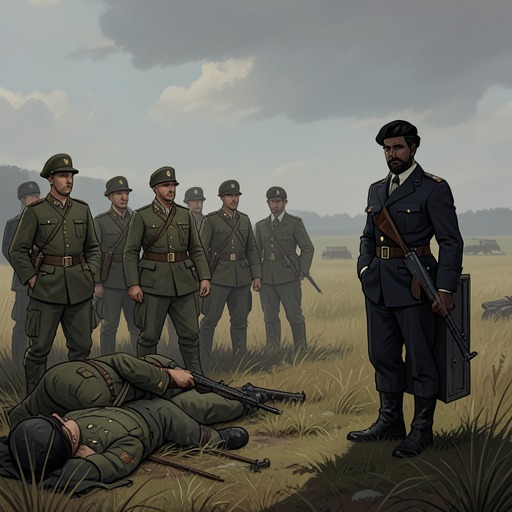
Mamiya’s Reunion with Boris Gromov
The Wind-Up Bird ChronicleMamiya’s Reunion with Boris Gromov is the spring 1947 encounter in which Lieutenant Mamiya recognizes the former Soviet officer who had ordered Yamamoto’s execution, now reduced to a prisoner in a Siberian mining camp. The moment turns a remembered wartime atrocity into a present-tense confrontation: Boris Gromov has lost his uniform and position, but not the danger he represents, and Mamiya’s recognition draws him into the camp’s corrupt system before he forms a plan to kill him.
Background: From Border Mission to Captivity
Years earlier, Mamiya had been assigned to escort Yamamoto on a secret mission across the Khalkha River. Mamiya was selected in part because he was responsible for mapping the western border of Manchukuo. The maps were incomplete, but uncertainty over the border had political consequences: the Kwantung Army wished to avoid provoking a clash with the Soviet Union or Outer Mongolia, while recognizing that a future conflict would require detailed military maps showing routes, campsites, water sources, and supplies. The mission’s geography work therefore existed at the intersection of military intelligence and a deliberately unsettled frontier.
Mamiya’s later service in Siberia brings that past into unexpected proximity with the present. By the time he sees Boris, he has been at the mining camp for a year and a half. The camp is administered as a strategic facility, with its labor force treated as replaceable: prisoners who die are replaced by new arrivals, and the director’s priority is rising production rather than workers’ survival. Against that institutional background, Boris appears not as an isolated former official but as someone whose earlier methods of violence have found a new setting within the machinery of imprisonment.
The Recognition at the Station
Mamiya dates the encounter to around the beginning of May 1947, after the snow had melted. On his way back from delivering a report to headquarters, he passes the station, where a group of Russian prisoners is breaking rocks and spreading the crushed stone over the roadway. A noncommissioned officer stops Mamiya to check his pass. Unable to read it, the officer summons one of the prisoners to read it aloud.
The prisoner is the man Mamiya recognizes. Boris is emaciated and largely bald, with a missing front tooth; his prison clothes, damaged shoes, and altered appearance contrast with the spotless officer’s uniform Mamiya remembers. Yet Mamiya is certain of his identity. The recognition brings back the terror of the earlier encounter so abruptly that Mamiya struggles to breathe. Boris, too, recognizes Mamiya, and appears astonished: he had evidently assumed that Mamiya had died in the well in which he had been left during the earlier ordeal.
The exchange at the checkpoint is brief and outwardly controlled. Boris reads Mamiya’s pass aloud, identifying his name, his translator’s role, and his authorization to move among the camp’s areas. The officer returns the pass and lets Mamiya continue. When Mamiya looks back, Boris is watching him. Mamiya cannot be sure whether the faint smile he sees is real, but the recognition has already made the two men’s shared past active again.
Boris’s Identity and the Camp’s Power Structure
A week later, Mamiya sees Boris again outside the station, still in chains and working with a hammer. Boris stands upright and smiles; Mamiya recognizes the expression from the earlier violence against Yamamoto. That second sighting gives Mamiya reason to ask a Russian officer named Nikolai about the prisoner. Nikolai identifies him as “Boris the Manskinner” and warns Mamiya to avoid him.
Nikolai supplies the name behind the nickname: Boris Gromov had been a major in the NKVD. In 1938, he was sent to Ulan Bator as a military adviser and organized the Mongolian secret police on the NKVD model, taking part in the suppression of suspected counterrevolutionaries. After the Battle of Nomonhan, he was recalled to Moscow and then sent to Soviet-occupied Eastern Poland, where he became notorious for torture. Nikolai’s account explains why Mamiya’s recognition matters beyond personal memory: Boris’s record connects the violence at the Khalkha River to a wider career serving coercive state institutions.
Boris’s fall from power has not made the mining camp safe. Mamiya initially imagines that internal political struggles in the Soviet Union may have brought Boris down, as officials who lost favor could be sent to prison camps. But Boris soon demonstrates that he can build power even as a prisoner. He recruits Mamiya to manage his affairs and places The Tartar over the violent side of his operation. Mamiya becomes indispensable to him, while Boris turns the camp and mine into territory he effectively controls.
Recruitment, Exploitation, and Mamiya’s Plan
Boris’s offer draws Mamiya into the camp’s illicit economy. Boris has diverted a substantial share of food, clothing, and medical supplies sent from Moscow and the International Red Cross, storing and selling them. He has also arranged the movement of coal through the black market, using bribes to influence railway workers and the stationmaster. Boris claims that the profits finance secret-police activity, but Mamiya believes that most of the wealth is being converted into Boris’s private fortune, including money sent to foreign accounts and invested in gold.
The scale of that enterprise rests on the camp’s treatment of prisoners as expendable labor. Boris assesses prisoners according to their usefulness, reducing rations for those he considers weak and directing the food toward stronger workers to increase production. When the workforce dwindles, new groups arrive by train; many die in transit or soon after arrival. The mine’s officials likewise prioritize production figures and authorize dangerous work regardless of mounting deaths. Boris’s system is therefore an extension, rather than a rejection, of the institution’s underlying logic: people are consumed and replaced in the pursuit of output and power.
Mamiya accepts Boris’s offer outwardly, but the acceptance conceals a different objective. He has no intention of helping Boris at the cost of his fellow prisoners, and the moment Boris presents the opportunity, Mamiya begins forming a plan to kill him. He knows that removing Boris would not end the camp’s broader brutality. Even so, he concludes that Boris cannot be allowed to continue living unopposed. The reunion thus opens not with reconciliation or escape, but with a covert struggle inside a system where Boris has made himself powerful and Mamiya has become close enough to act against him.
Narrative Significance
The scene is built around recognition delayed across years and radically changed circumstances. At the station, a pass check—an ordinary procedure in a camp divided by rules and controlled movement—forces Mamiya and Boris into direct contact. The identification proceeds through Mamiya’s memory, Boris’s altered appearance, and the account Nikolai later provides. This sequence makes the reunion both personal and historical: the man Mamiya remembers from the border mission is also a political operative whose career reaches across Mongolia, Poland, and the Soviet camp system.
The reversal is striking but incomplete. Boris has gone from military authority to chained prisoner, yet he rapidly establishes a new command through theft, bribery, and violence. Mamiya, meanwhile, moves from being the stunned witness to an apparent participant in Boris’s operations, while privately preparing to resist him. Their encounter therefore links Mamiya’s wartime memory to the next stage of his captivity and sets the terms of the conflict that follows: Boris’s power survives the loss of official rank, and Mamiya’s decision to act begins within the very system Boris has captured.